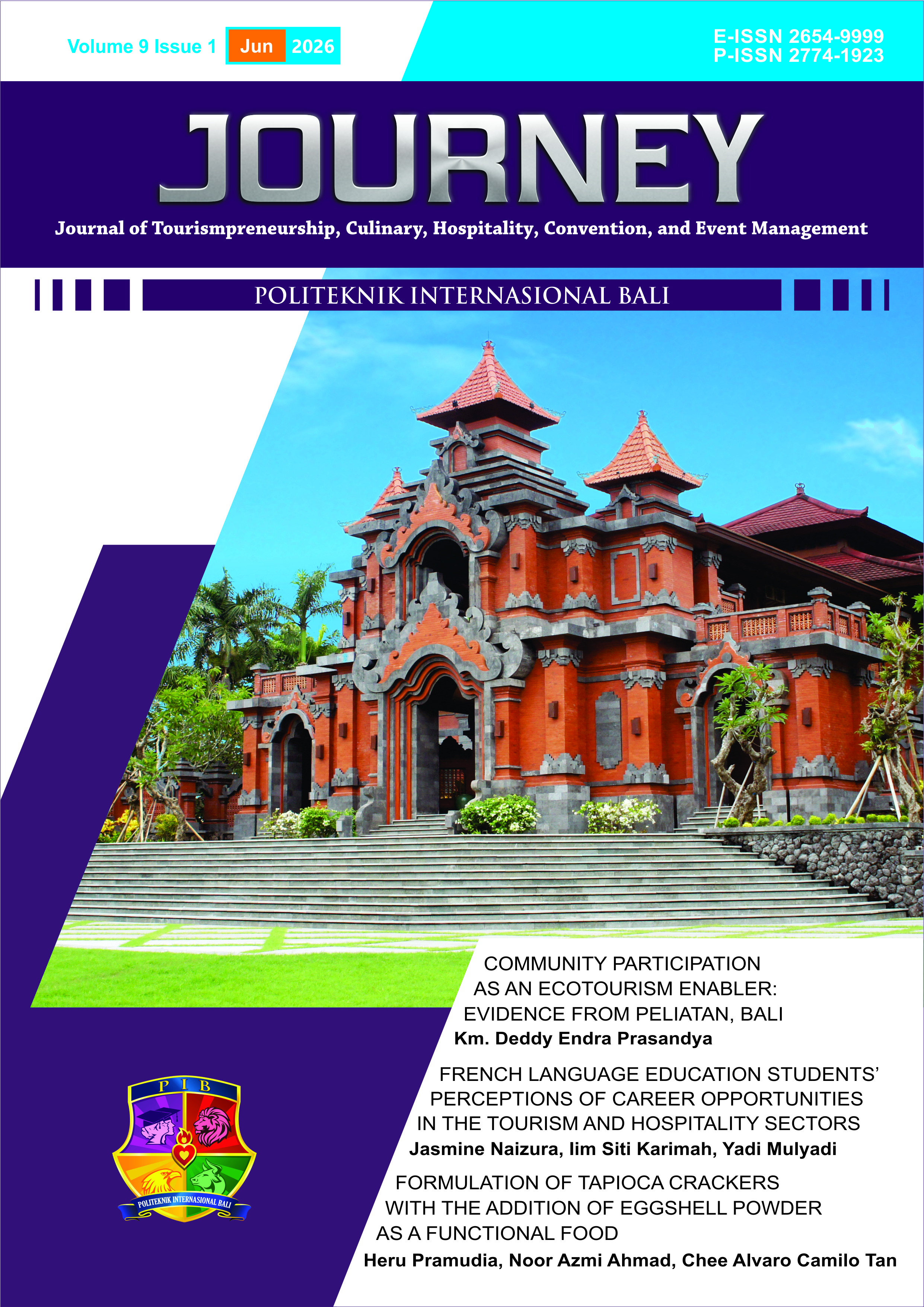
Formulation Of Tapioca Crackers With The Addition Of Eggshell Powder As A Functional Food
DOI:
https://doi.org/10.46837/journey.v9i1.386Keywords:
Tapioca Crackers, Eggshell Powder, Functional Food, Calcium, Organoleptic TestAbstract
This study aimed to formulate tapioca crackers with the addition of eggshell powder and to evaluate panelists’ acceptance of the resulting product. The use of eggshell powder was based on its high calcium content and its potential as a natural fortifying ingredient, as well as its role in converting food waste into value-added products. The research employed a descriptive qualitative approach, with data collected through observation of the production process and organoleptic testing using a 1–5 hedonic scale. The formulation consisted of 200 g of tapioca flour, 50 g of eggshell powder, 5 g of salt, 5 g of chicken powder, and 100 ml of hot water. The production process included mixing, dough shaping, boiling, cooling, slicing, drying, and two-stage frying to produce crispy crackers. Organoleptic testing was conducted with 32 untrained panelists who evaluated texture, aroma, taste, and appearance. The results showed that tapioca crackers with the addition of eggshell powder were generally well accepted by the panelists. Taste and texture received the highest preference scores, followed by appearance, while aroma was rated as acceptable but still requires further improvement. These findings indicate that the addition of eggshell powder did not negatively affect the sensory quality of the product and is compatible with the tapioca starch matrix. However, no chemical or laboratory analysis was conducted to determine the actual calcium content or nutritional composition of the final product. Therefore, the classification of this product as a functional food or a natural source of calcium cannot be scientifically confirmed and remains a potential claim. Further studies are required to analyze calcium content, proximate composition, and mineral bioavailability to support these claims. From a practical perspective, panelists’ feedback highlights opportunities for further product development, particularly in terms of flavor diversification. Suggested variants such as spicy, balado, and barbecue (BBQ), as well as improvements in aroma and packaging, indicate strong potential for enhancing consumer appeal and market competitiveness. Overall, this study provides an initial contribution to the development of innovative snack products based on natural fortification and food waste utilization, while emphasizing the need for further scientific validation of their nutritional value.
Downloads
Published
Issue
Section
License
Copyright (c) 2026 Heru Pramudia, Noor Azmi Ahmad, Chee Alvaro Camilo Tan

This work is licensed under a Creative Commons Attribution 4.0 International License.